Features
What PixelWright does today. Where something is built but not yet tested on real hardware, we say so.
Playback
- Layered playback of HAP, HAP Alpha, HAP Q, HAP Q Alpha, HAP R and BPV with exact cadence: 24/25/30/60p on 60 and 120 Hz without repeated or skipped frames.
- Zero-copy frame upload to the GPU; one decoding thread per layer with prefetch and pre-roll, loops without seeking and tolerance to damaged frames.
- Still images and image sequences (
render_0001.png…) as one clip. Other media is transcoded in the background on import to show-safe formats. - Floating-point canvas and outputs with dithering: slow fades and soft edges without banding. EXR, Display P3, Rec.2020 and HDR (PQ/HLG) converted to Rec.709 SDR on import.
- Audio tracks with waveform and clip sound in sync with the picture, with drift correction, per-layer volume and delay. The timeline can follow the sound card clock.
BPV codec
- Our own GPU-texture codec, like HAP, with LZ4, RDO, BC7 and checksums: 25–84 % smaller than HAP at equal quality, just as cheap to decode.
pixelwright-encodeconverts any video FFmpeg can read to BPV or the HAP family, and measures quality and decode speed.
3D stage and mapping
- LED screens built from panels with a wizard of real cabinet models (pitch, resolution and size computed), projection screens and OBJ, glTF and GLB models.
- Projectors with resolution, throw ratio, lens shift, aim-at-surface, warp and edge blending (edges, gamma and curve).
- Projection preview on the 3D stage: see badly blended overlaps and uncovered areas before you reach the venue.
- Point-based projector calibration: position, orientation and lens solved by least squares from crosses on the real projection.
- Slice mapping: perspective corner-pin, curved grid warp, polygon masks, soft edges, and import of slice presets from XML.
Cues, tracks and timecode
- Cues with GO / BACK, transition fades, and the next cue preloaded: four 4K layers on screen in the same frame as the GO.
- Cue actions: send control messages, OSC to other machines, MIDI or MSC to the lighting desk.
- Tracks (setlist): several timelines per show, switched from the studio, OSC, DMX, the API or Companion.
- Timecode in: LTC, MTC, Art-Net and OSC with smooth chase, freewheel and per-song TC ranges. Timecode out: LTC and MTC.
- A Live workspace for operators: program monitor, big timecode, GO, BACK, master and blackout.
Cluster
- Several PCs play one show: a main machine (studio or node), a backup that takes over without a cut, and render nodes on a common clock showing the same frame on every refresh.
- Automatic distribution of the show and all its media with hash verification; live edits are applied between frames.
- Every packet is signed with a key derived from the cluster password.
- Genlock with NVIDIA Quadro Sync on Windows (built, not yet tested on real hardware).
Generative content and nodes
- Layer types for video, audio, camera, NDI, web page, text, colour, gradient, strobe, chevron, scan, radar, generative content, node Blocks and shaders.
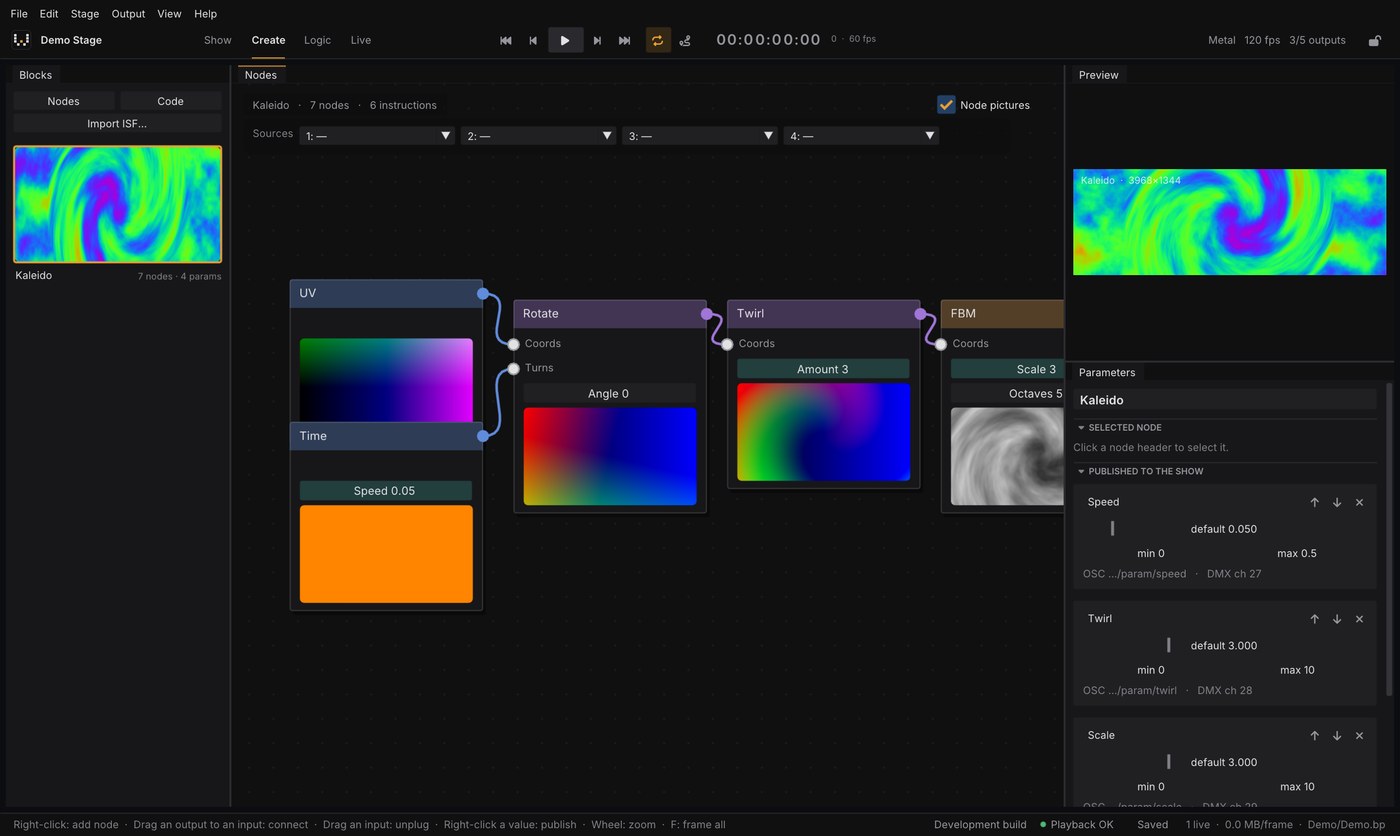
- About 40 nodes evaluated on the GPU, textures from cameras, NDI, web pages or other layers, feedback, keying, and GPU particles (one million at 120 fps on an M4 Pro).
- Code Blocks: paste GLSL or Shadertoy code, compiled hot, without cuts on errors. ISF shader import. A 3D scene with an instanced cloner and materials.
- Effects (blur, pixelate, mirror, kaleidoscope, edges and more) on any layer, effect layers, 14 blend modes and colour correction.
- AI background removal on cameras, NDI or pages (ONNX Runtime on CPU; NVIDIA Maxine on Windows with RTX).
Inputs, outputs and devices
- Outputs as visualiser, feeds, projector or canvas, with gain, contrast, gamma, RGB, test patterns and identify.
- Send any output over NDI and Syphon without making the show wait (tested with a test sender; not yet with third-party receivers).
- Live inputs: cameras and capture cards, and NDI when the NDI runtime is installed, with automatic reconnection.
- Web layers: any URL or local HTML app with full Chromium in an isolated process, with transparency and a JavaScript bridge to fire cues.
- LED pixel mapping over Art-Net or sACN, Blackmagic Videohub routers, PJLink projectors, MIDI, OSC, TCP and UDP devices.
Control
- OSC with wildcards and feedback, DMX over Art-Net and sACN (32 channels per layer, HTP/LTP merge, QLC+ fixture export).
- MIDI with learn and MIDI Show Control, REST and WebSocket APIs, and a web remote for tablets and phones served by the studio and each node.
- A Bitfocus Companion module.
Built not to stop
- On the render node the show and the render run off the main thread: blocking it for 2 s does not lose a frame.
- Show Lock: during the performance only transport, cues and control remain.
- Playback health in the status bar (late or dropped frames, empty decoder, damaged media), show logs and crash backtraces.
- Show folders with an encrypted and authenticated
.bpfile, atomic saves and backups. - Installations: states and transitions, touch zones (TUIO), serial port, weekly schedule, kiosk mode and a watchdog that relaunches the show.
pixelwright-node --soak <minutes>plays the show and gives a verdict on dropped frames, cadence and memory.
Platforms
Rendering goes through bgfx: Metal, Direct3D 11/12 and Vulkan. Everything has been developed and measured on an Apple Silicon Mac. Windows and Linux are designed to work but have not been validated on real machines yet.
Not there yet
Being clear about it saves you a surprise on site:
- Control layers on the timeline, Readout (timecode as image), LUTs, layer masks, several clips per layer and chained effects on one layer.
- Spout (Windows) and Blackmagic DeckLink (SDI) outputs.
- HDR / 10-bit output and editable per-clip colour management.
- The studio still runs in one thread: a file dialog freezes its live outputs. For shows, use
pixelwright-node. - FBX import, Notch Blocks and Lua scripting.
- Code signing: Gatekeeper and SmartScreen show a warning when installing.